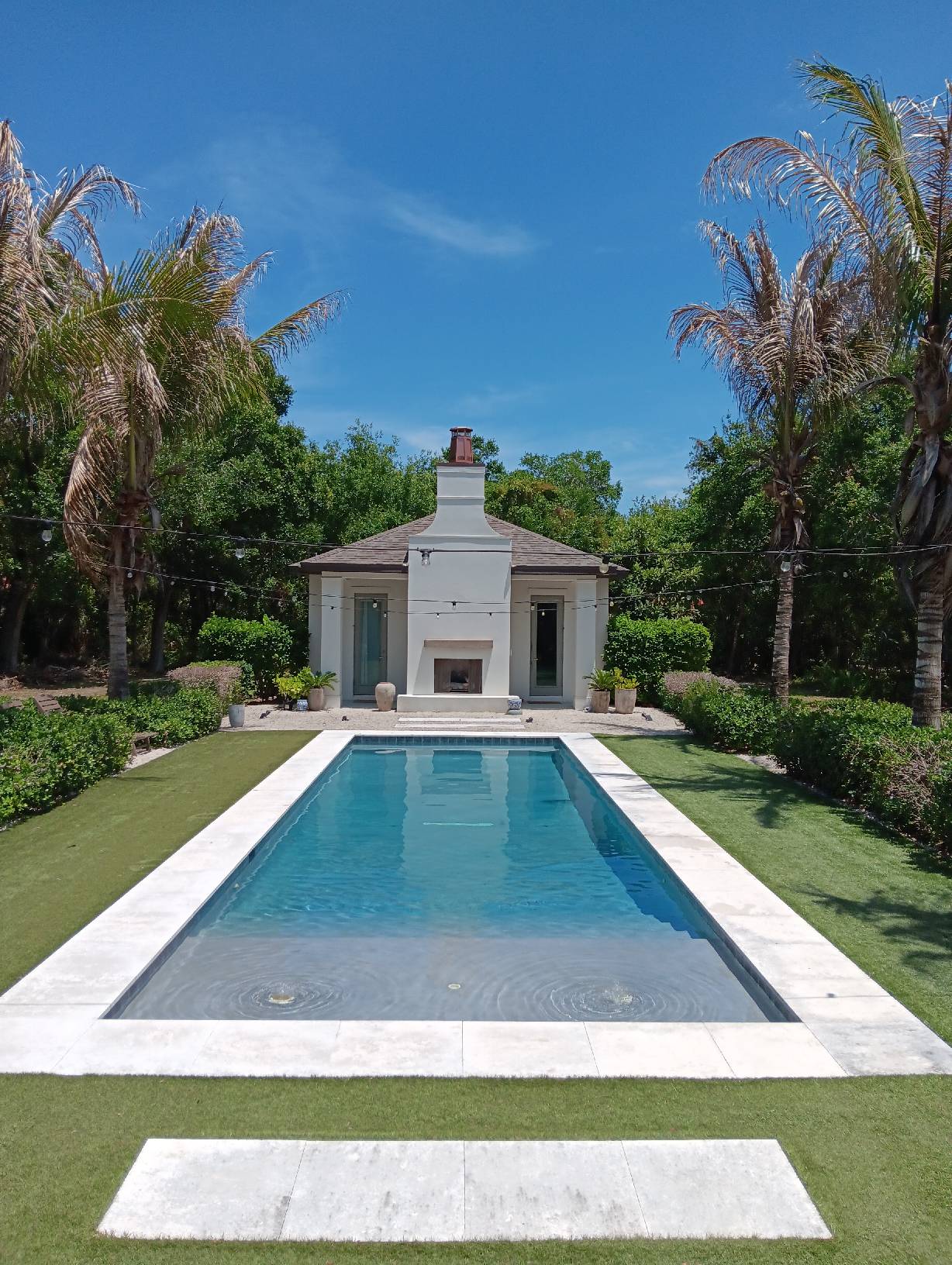
Landscaping around a Florida pool is a different job than landscaping the rest of the yard.
A raised planter can compromise a pool’s required safety feature. New pavers can push stormwater toward the deck. Irrigation overspray and fertilizer runoff can throw off pool chemistry within a week. A design that looks right on paper can cause years of problems if nobody accounted for mature plant sizes, gate clearance, equipment access, or the rules at that specific address.
Most homeowners don’t know which questions to ask, which leaves the landscaper as the first person able to raise them. This article covers the issues that come up most often on pool projects in Brevard County, with links to the sources where the current requirements live.
At A Reliable Pool Service we service more than 700 pools a week across Melbourne, Palm Bay, and the surrounding areas. We see what separates landscaping that works with a pool from landscaping that creates years of cleaning, chemistry, and access problems.
Please read first. This is general information from a pool service company. It is not legal advice, engineering advice, or a compliance standard for the landscape trade. Statutes, codes, and local ordinances change by legislative session and differ by jurisdiction, property, and project scope. Requirements for any specific job come from the building department, the association’s governing documents, the utility operator, or a licensed professional.
Regulatory references were reviewed in August 2026. Links point to the current sources so you can confirm the language yourself.
First, Find Out Which Rules Apply to This Pool
Reviewed August 2026.
This step gets skipped, and it changes everything downstream.
Florida’s Residential Swimming Pool Safety Act, Chapter 515, took effect October 1, 2000. Its core requirement, s. 515.27, attaches at a specific moment: “In order to pass final inspection and receive a certificate of completion, a residential swimming pool must meet at least one of the following requirements relating to pool safety features.” Four options follow: a barrier meeting s. 515.29, an approved safety cover, exit alarms on doors and windows with pool access, or qualifying self-closing and self-latching devices on those doors.
Because the duty attaches at final inspection, the chapter imposed no retrofit requirement on pools already finished when it took effect. Much of Brevard County’s pool inventory predates October 2000. On those properties the standard is generally the code and local ordinance that applied when the pool was permitted, plus the Florida Building Code for later alterations. Section 515.37 also exempts political subdivisions whose ordinances are equal to or more stringent than the chapter.
The practical point: applying the Chapter 515 framework to a 1988 pool can lead you to the wrong conclusion about what that fence is and what it can do.
| When the pool was completed | What generally governs its safety feature | What that means before you design |
|---|---|---|
| Certificate of completion on or after Oct. 1, 2000 | Chapter 515. s. 515.27 sets the safety-feature options; s. 515.29 sets barrier characteristics. | The approved feature may be a barrier, a safety cover, exit alarms, or self-closing doors. A fence on the property is not automatically it. |
| Completed before Oct. 1, 2000 | The code and ordinance in effect when the pool was permitted. The Florida Building Code governs later alterations. | Chapter 515’s options may never have applied. Ask what the permit record shows rather than assuming. |
| Any pool inside a municipality | s. 515.37 exempts subdivisions with ordinances equal to or more stringent than the chapter. | Melbourne, Palm Bay, West Melbourne, Rockledge, and unincorporated Brevard can differ. Confirm at the address. |
| Pool altered, re-decked, or re-permitted recently | The Florida Building Code edition in force at that permit. | A recent alteration can pull an older pool into current barrier requirements. Worth asking. |
Swipe the table horizontally to see all columns.
Identify the Safety Feature Before You Estimate
Reviewed August 2026.
Once you know the framework, find out which physical feature does the safety work. It might be a fence, a screen enclosure, an approved cover, door and window alarms, or self-closing doors.
Where a barrier is the feature, s. 515.29 lists four characteristics. In the statute’s words, the barrier must be “at least 4 feet high on the outside.” It may not have “any gaps, openings, indentations, protrusions, or structural components that could allow a young child to crawl under, squeeze through, or climb over the barrier.” It must be “placed around the perimeter of the pool” and separate from a yard fence unless that fence sits on the pool perimeter and meets the barrier requirements itself. And it must be “placed sufficiently away from the water’s edge” to prevent someone who penetrates it from falling straight in. Under s. 515.27, gates open outward away from the pool and are self-closing with a self-latching device.
Landscaping can affect every one of those without anyone touching the fence.

| Landscape element | Why it can matter | Question worth raising |
|---|---|---|
| Raised planters, benches, boulders, stacked material | s. 515.29(b) covers structural components a young child could climb over. | Does anything near the barrier create a foothold, now or at mature size? |
| Added soil, mulch, or regrading at the fence line | s. 515.29(a) measures height on the outside of the barrier. | Does the finished grade change the effective height? |
| Shrubs or beds in a gate’s swing path | Gates open outward and must self-close and self-latch. | Can the gate swing fully and latch once the plants fill in? |
| Trees, trellises, arbors, large specimens | Climbing points can develop years after installation. | What does this look like in five growing seasons? |
| Work at a screen enclosure | s. 515.29(c) covers when a surrounding enclosure can serve as the barrier. | Is the enclosure the permitted safety feature here? |
| Plantings between the barrier and the water | s. 515.29(d) covers placement away from the water’s edge. | Does the design change how a person moves between barrier and pool? |
Swipe the table horizontally to see all columns.
Florida law sets no single planting setback. Each design has to be judged against the actual barrier, the grade, the mature plant size, and the property layout. Where there’s doubt, more clearance and a check with the building department or a licensed pool contractor is the cheaper path.
Document Existing Conditions First
Pool landscaping tends to expose problems the landscaper didn’t create. A ten-minute photo pass protects you.
Photograph the fence or enclosure, gate operation and latch condition, the equipment and visible plumbing, drainage patterns, cracked or uneven deck areas, irrigation heads and visible lines, and anywhere soil is already washing onto the deck.
Those photos protect you and show the homeowner what may need attention before the project moves. If a gate already fails to close or the barrier looks compromised, send a short email before work starts.
Protect the Grade and Drainage
You don’t need grading equipment to change how water moves around a pool. Raised beds, added soil, edging, pavers, retaining walls, and compacted ground can all push runoff toward the deck, the house, a neighbor, or the enclosure.
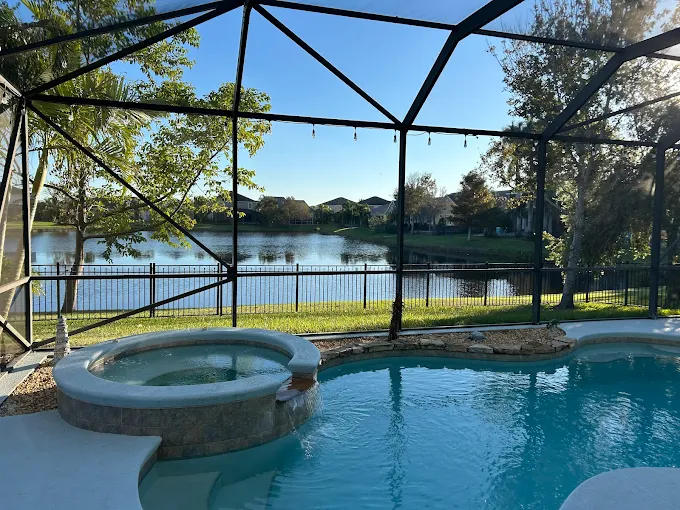
A plan that holds up keeps runoff away from the pool and house, keeps soil and mulch off the deck, preserves existing swales, and accounts for the runoff any new hard surface creates. It also avoids raising the exterior grade along a barrier, avoids standing water beside an enclosure, and avoids sending runoff onto the neighbor’s lot.
Significant grading, retaining walls, drainage systems, and larger hardscape may require professional plans or local approval, and the thresholds differ across Brevard County, Melbourne, Palm Bay, West Melbourne, and Rockledge. A project doesn’t stay ordinary landscaping just because plants are in the scope.
Call 811, and Know What 811 Won’t Mark
Reviewed August 2026.
A pool yard can hide electrical service, gas, communication cable, irrigation, pool plumbing, and drainage pipe. Sunshine 811 instructs excavators to “notify Sunshine 811 at least two full business days before you want to dig,” excluding weekends and holidays. The process is set out in s. 556.105, part of the Underground Facility Damage Prevention and Safety Act.
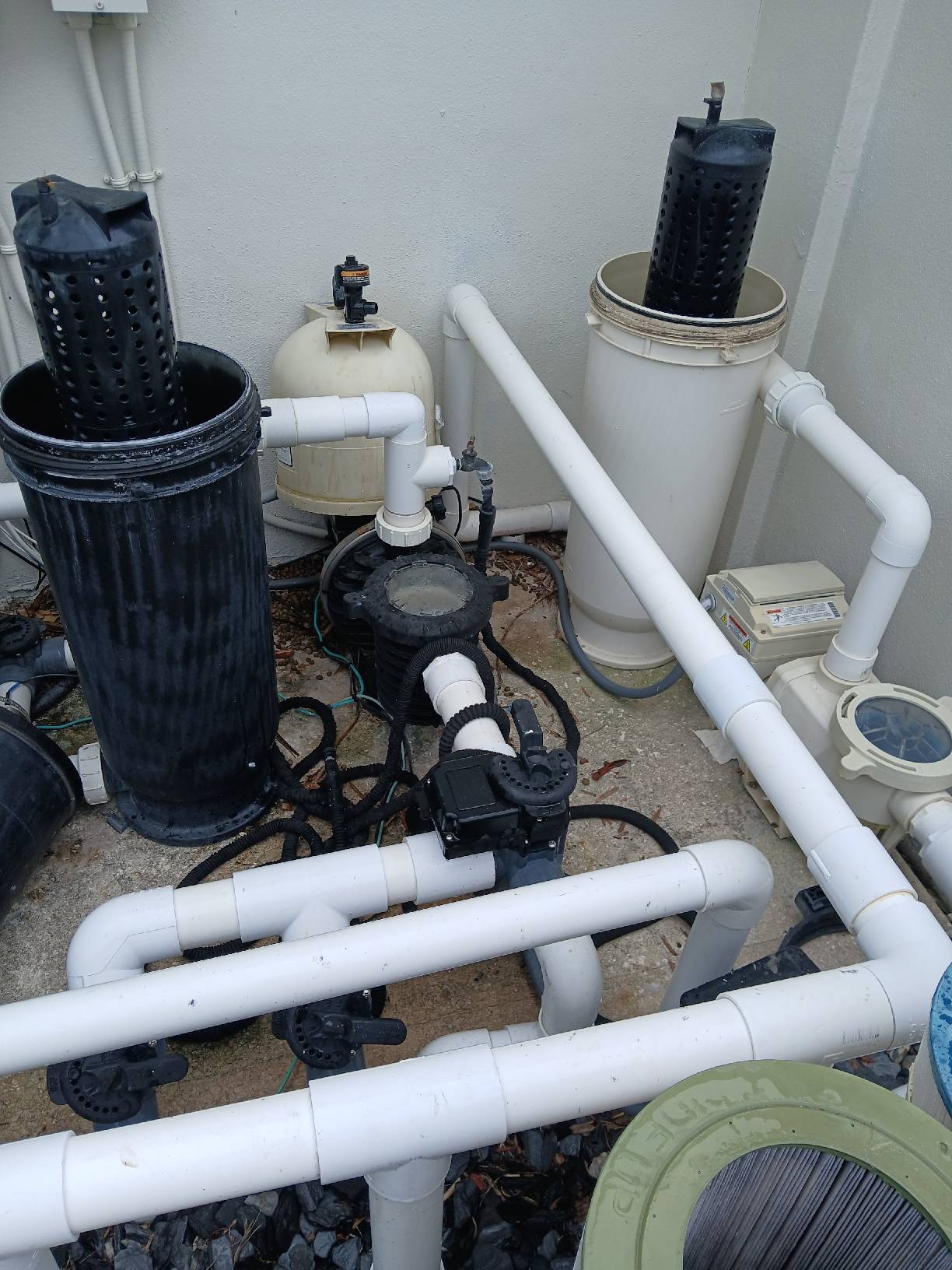
The catch: a ticket reaches the facilities of participating member operators. Privately installed lines, the ones most likely to be in your way, generally are not included.
| Facility | Marked by a standard locate? |
|---|---|
| Electric, gas, water, sewer, telecom owned by participating utilities | Yes, where the operator is a member |
| Utility-owned lines up to the point of service | Yes |
| Pool circulation, suction, and return lines | No |
| Pool light conduit and bonding wire | No |
| Irrigation mains, laterals, valve wiring | No |
| Low-voltage landscape lighting cable | No |
| Private gas lines past the meter | No |
| Yard drains, French drains, downspout tie-ins | No |
| Lines serving spas, fountains, water features | No |
Swipe the table horizontally to see all columns.
Ask the homeowner for any plans, and walk the route between the pool and the pad before you dig. If you can’t establish where the private lines run, a private locate or a call to the pool contractor costs far less than a cut circulation line and an emergency pool repair in Melbourne.
Preserve Access to Pool Equipment
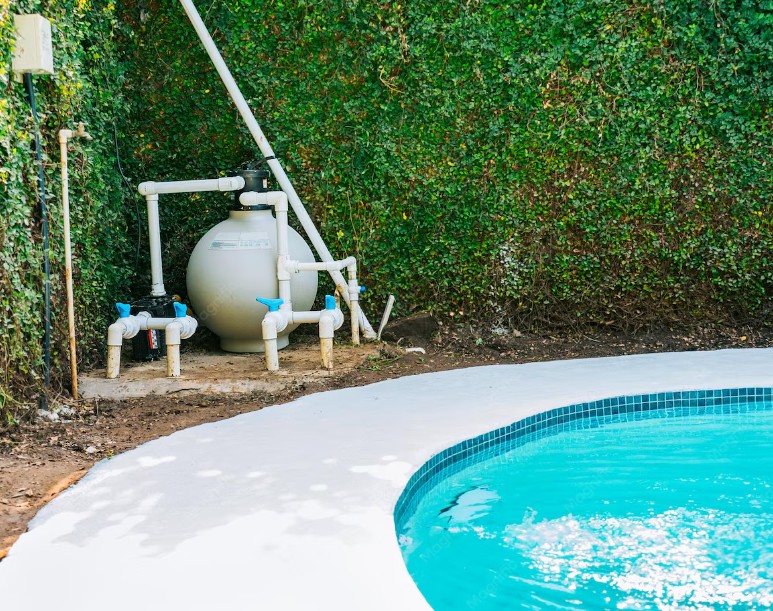
Landscaping shouldn’t stop a technician from safely reaching the pump, filter, heater, valves, or electrical controls.
Think mature size, not nursery size. Shrubs that look well spaced on install day can block ventilation, trap moisture, hide leaks, and turn a routine filter cleaning into a wrestling match within two seasons. A technician needs room to open and clean the filter, reach valves and controls, pull and replace equipment, inspect plumbing, and move safely around the pad.
Two habits prevent most of it. Keep aggressive roots away from underground plumbing and pads, and aim irrigation heads so they never spray motors, controls, or heaters. When equipment fails behind overgrown shrubs, the repair gets slower and more expensive for everyone, including the landscaper who gets blamed.
Keep Irrigation and Runoff Out of the Pool
Overspray puts untreated water into the pool, affecting sanitizer levels, pH, and balance. Runoff carries soil, fertilizer, mulch, and organic debris straight in.

Point spray heads away from the pool and equipment, and consider drip lines for beds near the deck. Fix any head spraying through a screen enclosure, avoid overwatering beds along the deck edge, and make sure nothing pools along the enclosure or blocks a gate.
Then verify in the field. Running each zone and watching the actual pattern takes a few minutes and catches the problems that surface three weeks later as a chemistry complaint.
Choose Pool-Friendly Plants
The right plant near a pool is often not the plant you’d pick for the same spot elsewhere. Leaves, flowers, berries, seed pods, pollen, and loose mulch all reach the water eventually. That debris adds filter and skimmer load and feeds the phosphates that drive algae in Florida heat, the same cycle behind most of the green pool cleanups we get called for after a landscape install.

| Trait | Why it matters near a pool | Where to check |
|---|---|---|
| Litter volume and type | Leaves, berries, and pods raise filter load, chlorine demand, and phosphates. | Nursery specs; local mature specimens |
| Mature height and spread | Sets clearance from barriers, gates, enclosures, and the pad. | UF/IFAS Florida-Friendly Landscaping™ plant guide |
| Root behavior | Surface and aggressive roots reach plumbing, decks, and pads. | UF/IFAS species profiles |
| Salt and wind tolerance | Critical on the barrier island and near the Indian River Lagoon. | UF/IFAS coastal plant lists |
| Thorns and irritant sap | Poor fit beside walkways, deck edges, and pool entries. | Species profile |
| Invasive status | Some species are restricted or discouraged in Florida. | UF/IFAS assessment |
| Water and fertilizer demand | High-input plants near a deck raise runoff risk in the rainy season. | Florida-Friendly Landscaping™ principles |
Swipe the table horizontally to see all columns.
Spec mature height and width in the plan, especially near enclosures, fences, decks, equipment, and underground plumbing. Florida-Friendly Landscaping™ principles are a useful framework: right plant, right place, water conservation, reduced runoff, responsible fertilizer use.
Fertilizer: The Blackout Window and the Credential
Reviewed August 2026. Verify the ordinance for the actual project address before applying.
Fertilizer left on a deck, pavers, or a driveway washes into the pool, into storm drains, and eventually into the Indian River Lagoon. Brevard County has detailed local rules here, and there’s a state credential that applies to whoever is applying.
What the Brevard ordinance provides
The Brevard County fertilizer ordinance, Chapter 46, Article VIII, applies to unincorporated Brevard County. Municipalities can adopt their own versions.
| Provision | What the ordinance provides | Section |
|---|---|---|
| Restricted application period | No nitrogen or phosphorus fertilizer on turf or landscape plants from June 1 through September 30. | § 46-338 |
| Prohibited conditions | No application to saturated soils, or during flood, tropical storm, or hurricane watches and warnings. | § 46-338 |
| Fertilizer-free zone | No application within 15 feet of surface waters, with a limited exception for newly planted material within 60 days. | § 46-339 |
| Impervious surfaces | No fertilizer applied, spilled, or deposited on impervious surfaces. Accidental deposits are to be “immediately and completely removed.” | § 46-342 |
| Commercial applicators | Required to complete the specified training and carry evidence of FDACS certification. | § 46-346 |
| Institutional applicators | At least one employee holding a Green Industries BMP certificate before a business tax receipt. | § 46-346 |
| Scope | Applies within unincorporated Brevard County. | § 46-337 |
Swipe the table horizontally to see all columns.
The state certification that goes with it
Separate from the ordinance, s. 482.1562 provides that since January 1, 2014 anyone applying commercial fertilizer to an urban landscape must hold a Limited Certification for Urban Landscape Commercial Fertilizer Application from the Florida Department of Agriculture and Consumer Services.
The application is supported by “a copy of the training certificate issued pursuant to s. 403.9338,” the Green Industries Best Management Practices training, plus a fee. Certifications run four years, and renewal requires four classroom hours of continuing education with at least two on fertilizer best management practices. The statute exempts yard workers who apply fertilizer only to individual residential properties using fertilizer and equipment supplied by the owner or resident.
Training runs through the UF/IFAS GI-BMP program, and certification through FDACS. If fertilizer is in your scope on a Brevard job, settle the credential question before the crew is on site.
Tell the homeowner to watch the water
After fertilizing or installing new soil and mulch, tell the homeowner to keep an eye on the pool. Runoff shifts chemistry fast in the rainy season, and a green pool a week after a landscape install is usually not a coincidence.
When the Work Stops Being Landscaping
Planting and ordinary maintenance typically don’t require a building permit. A project moves into regulated territory once it includes fence or enclosure alterations, retaining walls, deck or coping changes, permanent electrical, gas lines, plumbing or drainage systems, large hardscape, pergolas, outdoor kitchens, built-in seating, or anything touching an easement or setback.
Thresholds depend on the project and the jurisdiction. The most useful thing you can do is identify in writing which parts of the job fall outside the landscape scope, and have the homeowner confirm approvals before construction. A pool barrier should never be relocated, removed, or modified to ease installation unless that work is properly coordinated and authorized.
HOA and ARC Approval Before Materials Are Ordered
Reviewed August 2026.
Association approval needs to be settled before anything is ordered or installed. The homeowner submits the application, but a complete package from you moves it much faster.
| What to supply | Why committees ask for it |
|---|---|
| Site plan with dimensions | Shows bed locations relative to the pool, barrier, enclosure, and property lines. |
| Plant list with mature sizes | Lets the committee judge the design as it will look, not as it installs. |
| Distances from fences and enclosures | Answers the clearance questions that generate most requests for more information. |
| Hardscape colors, materials, samples | Appearance standards are where most denials originate. |
| Drainage and irrigation notes | Shows the project won’t move water onto a neighboring parcel or common area. |
| Contractor license and insurance | Commonly required by the declaration before work is authorized. |
| Photos or product literature | Cuts back-and-forth and speeds review. |
Swipe the table horizontally to see all columns.
On the legal side, s. 720.3035 provides that architectural review authority comes from the declaration or from published standards the declaration authorizes, not from the committee’s own judgment. Following 2024 amendments, a written denial must identify both the specific rule relied upon and the specific part of the proposal that doesn’t conform. A general statement that a proposal fails the architectural guidelines is not what the statute describes.
Section 720.3075 addresses Florida-Friendly Landscaping™ and limits an association’s ability to prohibit qualifying installations, though a lawful review process and compatible appearance standards still apply.
Most declarations set their own response deadline, often 30, 45, or 60 days from a complete submission. Those deadlines live in the governing documents, not the statute, so check the declaration. Either way, don’t start on a verbal approval. The written approval belongs in the project file.
Before the next section. What follows is a set of questions that come up on pool projects. It’s a conversation starter for a walkthrough, not a professional standard, a code checklist, or a compliance procedure. Every property is different, and nothing here replaces the building department, the governing documents, the utility operator, or a licensed professional.
Questions Worth Asking Before You Break Ground
- When was this pool completed, and which framework applies?
- Which feature is the pool’s safety feature: barrier, cover, alarms, or self-closing doors?
- Could anything here create a climbing point or change the barrier’s effective height?
- Can every gate still open, close, and latch freely once the plants mature?
- Have existing conditions been photographed and shared with the homeowner?
- Does the project change grade or drainage, and where does the extra runoff go?
- Have public utilities been located, and has anyone accounted for private pool and irrigation lines?
- Will mature plants stay clear of underground plumbing and the pad?
- Can a technician still reach, service, and replace equipment?
- Will any irrigation head spray into the pool or onto electrical components?
- Do fertilizer restrictions apply at this address this season, and does the applicator hold the required certification?
- Does any part of the scope require a permit or fall outside ordinary landscaping?
- Has the homeowner provided written association approval where required?
Working With the Homeowner’s Pool Company
Landscapers and pool technicians work on the same system from different directions. Early coordination on larger projects prevents most of the problems above. A pool professional can flag likely circulation-line routes, clearance issues, chemistry risks, and conflicts with the barrier before they become change orders.
After construction, the water should be tested. Soil, fertilizer, mulch, pressure-washing residue, and irrigation runoff shift chemistry quickly, especially in a Brevard summer.
If you handle the landscape, we can handle the water
A Reliable Pool Service provides weekly pool service in Melbourne, green pool cleanup, saltwater pool service, and pool repair across Brevard County, including Palm Bay, Rockledge, Viera and Suntree, Satellite Beach, and Palm Shores.
If a client’s pool turns after a landscape project, or you want a pool company you can refer with confidence, call (321) 271-5800 or check service availability.
Need help on the landscape side?
We’re regularly asked to recommend a landscaper for pool-area work in Brevard County. GroundTec, Inc. is a qualified landscape contractor serving the area, and a reasonable place to start for homeowners and builders who need design and installation help around a pool.
Working with a homeowner instead of a contractor? Our companion article, Landscaping Around a Pool in Florida: A Homeowner’s Planning Guide, covers the same ground from the property owner’s side. Useful to send before a design conversation.
Frequently Asked Questions
Does Florida’s pool barrier law apply to every Florida pool?
Not in the same way. Chapter 515’s safety-feature requirement attaches when a residential pool passes final inspection and receives a certificate of completion, and the chapter took effect October 1, 2000. Pools finished before that date are generally governed by the code and ordinance in effect when they were permitted, with the Florida Building Code applying to later alterations. Section 515.37 also exempts political subdivisions with equal or more stringent ordinances, so the answer can differ by city.
What should landscapers check before working around a Florida pool?
Establish when the pool was completed and which rules apply, identify the safety feature, document existing conditions, evaluate grade and drainage, request markings through Sunshine 811, account for private pool and irrigation lines, and confirm equipment access, permit scope, and association approval before starting.
How close can landscaping be to a pool fence in Florida?
Florida law sets no universal planting distance. Section 515.29 describes a barrier at least four feet high on the outside, without gaps, indentations, protrusions, or structural components that could let a young child crawl under, squeeze through, or climb over it. Whether a specific planting affects that is a property-by-property evaluation, and mature plant size has to be part of it.
Does an 811 locate include pool plumbing and irrigation?
Generally not. A ticket reaches the facilities of participating member operators. Private pool circulation lines, light conduit, irrigation, landscape lighting, private gas lines past the meter, and yard drainage are typically not marked, so a private locate or coordination with the pool contractor may be needed.
Do landscapers in Brevard County need a certification to apply fertilizer?
Section 482.1562 provides that anyone applying commercial fertilizer to an urban landscape must hold a Limited Certification for Urban Landscape Commercial Fertilizer Application from FDACS, supported by the Green Industries BMP training certificate. The Brevard ordinance separately requires commercial applicators to complete training and carry evidence of FDACS certification. There’s a statutory exemption for yard workers using fertilizer and equipment supplied by the property owner.
When is the fertilizer blackout period in Brevard County?
The ordinance provides that fertilizer containing nitrogen or phosphorus is not applied to turf or landscape plants from June 1 through September 30 in unincorporated Brevard County. Municipalities may have their own versions, so the ordinance for the project address governs.
Is the landscaper responsible for obtaining HOA approval?
The homeowner usually submits the application, but the landscaper often supplies the plans, plant specifications, samples, and contractor documentation the committee needs. Work shouldn’t begin until the homeowner provides written approval.
Can landscaping affect pool chemistry?
Yes. Soil, fertilizer, mulch, irrigation runoff, pollen, and plant debris can increase chlorine demand, shift water balance, raise phosphates, and feed algae.
Should the pool be tested after a landscaping project?
Yes, after planting, fertilization, mulching, pressure washing, hardscape installation, or any significant work near the water.
About the Author
Trey Doherty has 20+ years in the Florida pool industry and leads A Reliable Pool Service, a family-owned company based in Melbourne. The company services more than 700 pools a week across Brevard County and is a longtime member of the Florida Swimming Pool Association.
Disclaimer. This article provides general information and reflects sources reviewed in August 2026. It is not legal, engineering, or code-compliance advice, and it is not a professional standard for the landscape industry. Statutory citations, ordinance provisions, and permit thresholds change and vary by property, jurisdiction, project scope, and pool configuration. Confirm project-specific requirements with the building department, the association’s governing documents, the utility operator, or a qualified licensed professional.

