Pool Inspection in Brevard County, FL
Buying a house with a pool in Melbourne, Palm Bay, Satellite Beach or anywhere else in Brevard County? A pool inspection is a different job than a home inspection. We look at the shell, the equipment pad and the safety barrier the way a pool company looks at them, before the money moves.
Family owned. Licensed and insured. 100+ Google reviews. More than 700 Brevard County pools serviced every week.
The shell and the water
Plaster, tile, coping and deck, plus whether the pool is holding its water line or quietly losing it.
The equipment pad
Pump, filter, heater, salt cell and timer, read for age, condition and correct sizing rather than just whether they switch on.
The safety barrier
Fence height, gate latch, screen enclosure and whether doors and windows with pool access have alarms on them.
What does a pool inspection cover?
A pool inspection covers four things. The shell and its finish, the deck and the safety barrier, the water and how it is circulating, and the equipment pad. On the pad that means the pump, the filter, the heater, the salt cell, the timer and the electrical bonding, checked for age, condition and correct sizing rather than just whether they switch on.

Shell and finish
Hairline cracking, hollow spots behind the tile, plaster wear, and staining that points at metals in the water.
Tile, coping and deck
Loose tile, coping that has lifted, and deck cracking that follows the line of a buried pipe.
Skimmer, returns and drain
The skimmer throat is one of the most common failure points on a Florida pool and one of the easiest to miss.
Equipment age
Most pumps, heaters and salt systems are date coded in the serial number. That turns a guess about age into an actual date.
Flow and turnover
Whether the pump is sized to turn the water over for the volume of the pool, and whether a variable speed pump is actually programmed to do it.
Electrical bonding
The bonding that ties the metal on the pad together. It is a safety item and it is the one that gets skipped on equipment swaps.
Water loss
A bucket test run over 24 hours separates real water loss from Florida evaporation before anyone uses the word leak.
Heater or heat pump
The piece most likely to have already been replaced once. Its age and its warranty status both come with the house.
Barrier and enclosure
Fence height, gate latch, screen cage condition, and alarms on doors and windows with pool access.
Is a pool inspection the same as a home inspection?
No. A general home inspection covers the pool at a visual level, and most home inspectors say so in their own scope of work. They confirm the equipment runs and the deck is not falling apart. A pool company reads the pad instead, which is how you learn the pump is nine years old, the heater was never bonded, or the filter is undersized for the pool.
A general home inspection
- Confirms the pump and heater switch on
- Notes visible deck and coping damage
- Records that a barrier exists
- Gives the pool roughly one paragraph
- Correct scope for the job they were hired to do
A pool company inspection
- Dates the pump and heater from the serial number
- Checks turnover against the volume of the pool
- Looks for bonding that was never reconnected
- Separates evaporation from actual water loss
- Reads deck cracking against where the pipes run

The two are not in competition. They answer different questions. The problem is what sits inside that one paragraph. On a Brevard County property the pool is often the most expensive system on the lot after the roof and the air conditioning, and it is the one nobody prices before closing. A pump, a heater and a salt cell all have a service life. So does the plaster. None of that shows up in whether the water is clear on the day of the walkthrough.
What a pool inspection finds on a Brevard County pool
Brevard pools age differently depending on which side of the river they sit on. A pool three blocks from the ocean in Satellite Beach is not the same purchase as a pool in Viera, even if the listing photos look identical.
Beachside salt air. In Satellite Beach, Indialantic, Melbourne Beach and Cocoa Beach the air works on fasteners, heat pump coils and pad hardware from the outside in. Equipment does not get the same years there that it gets inland.
Screen enclosures. Cage anchors, panel condition and the door latch all matter, and the enclosure is part of the pool conversation with your insurer rather than a separate one.
A high water table. A Florida pool does not get drained casually, because an empty shell can shift or float where the ground water sits close to the surface. That changes how a shell problem is diagnosed and how it gets repaired.
Older inland pools. Plenty of Melbourne and Palm Bay pools still have a single speed pump on the pad running Florida hours. That is a running cost the listing does not mention.
What does Florida law require for a residential pool?
Florida’s Residential Swimming Pool Safety Act, Chapter 515 of the Florida Statutes, requires a new residential pool to have at least one approved safety feature. That can be a barrier at least four feet high, an approved safety pool cover, exit alarms on doors and windows with pool access, self closing and self latching devices, or a pool alarm. The requirement is written for new pools and does not force an existing pool to be retrofitted.
That gap is the part worth understanding before you buy. A pool built in 1984 can be completely legal and still have a gate that does not latch and no alarm on the slider. Nothing in the statute makes the seller fix it.
So there are three answers to the safety question and they are not the same answer. What the statute requires. What your insurance carrier wants to see. And what you want around your own kids. We can tell you what is physically there and what condition it is in. Your agent and your carrier are the right people for the other two.
What does it cost to skip the pool inspection?
The equipment on the pad at closing carries two things that transfer with the house. Remaining service life, and warranty status. Most manufacturer warranties on pool equipment are only valid when a licensed professional did the install, so a pump that was swapped in by a previous owner or a handyman may have no coverage left at all.
Buyers tend to price a pool as a nice feature and a chemical bill. The real number is the pad. A pump, a heater or a salt system is a meaningful installed cost, and the sticker on a box is never the installed cost. Our guide to what pool equipment really costs in Brevard County walks through the difference and why the warranty question matters more than the price tag.
An inspection does not stop any of that from being true. It just means you know it before you sign instead of in month four.
For Brevard County real estate agents and buyers
If you are writing an offer on a Brevard house with a pool, the pool is the piece of due diligence that is easiest to skip and hardest to unwind afterward. Agents send us their buyers. Buyers send us the questions their home inspector could not answer.
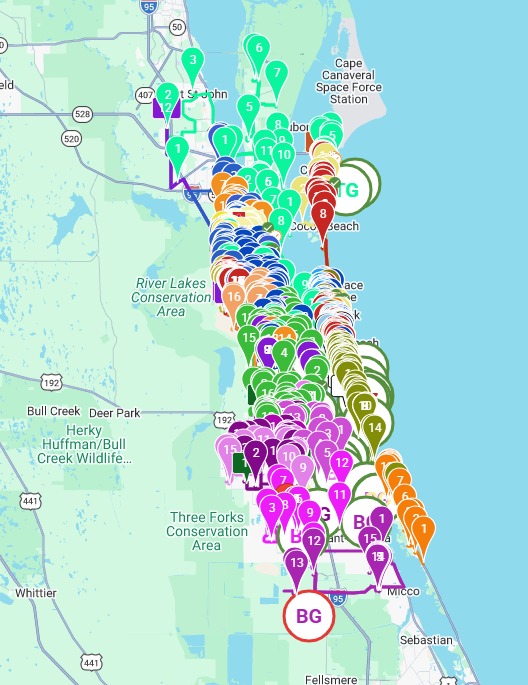
We service more than 700 pools a week from Titusville down to Micco, which usually means we have already worked on the street, and often on the pool next door. See where we run in our Brevard County service areas.
After closing, most buyers want the same three things. Weekly pool service so the water stops being a chore, pool equipment repair for whatever the inspection turned up, and occasionally a green pool cleanup when the house sat empty through a Florida summer.
Request a pool inspection
Tell us where the house is and where you are in the process. If you are on a deadline, call (321) 271-5800 and say so.
Pool inspection questions Brevard buyers ask
No. It is not required by law and it is not part of a standard home inspection. It is due diligence you choose, the same way you would choose a separate roof, septic or seawall inspection on a property that has one.
Most pumps, heaters and salt systems carry a manufacturing date coded into the serial number. That turns the seller thinking it is a few years old into an actual date, which is what tells you how much service life is left in it.
Yes. A neglected pool tells you more than a clean one, not less. What matters is working out whether the problem is chemistry, circulation, or something structural underneath it, because those are three very different numbers.
It will tell you whether the pool is losing more water than evaporation explains. Normal evaporation in Florida runs roughly a quarter inch a day. A bucket test over 24 hours measures the pool and the bucket side by side, which is what separates a real loss from a hot week.
Yes. The pad cannot be properly checked with the power off. If the house is vacant and the breaker has been pulled, that needs sorting before the visit or half the inspection is a look rather than a test.
Then you know before you sign. Some of what turns up is routine maintenance, some is a negotiating point, and some is a real number you want in the deal. Telling those three apart is the entire reason to do it.
Yes. We run pools across Brevard County from Titusville down to Micco, including Palm Bay, Viera, Suntree, Rockledge, Merritt Island, Satellite Beach, Indialantic, Melbourne Beach, Cocoa and Cocoa Beach.
Equipment Brands We Service and Repair
Pumps, filters, heaters, heat pumps, salt systems and automation from the brands Brevard County pools run on.


Get the pool looked at before you sign
A Reliable Pool Service is a family owned Brevard County pool company serving more than 700 pools every week.